

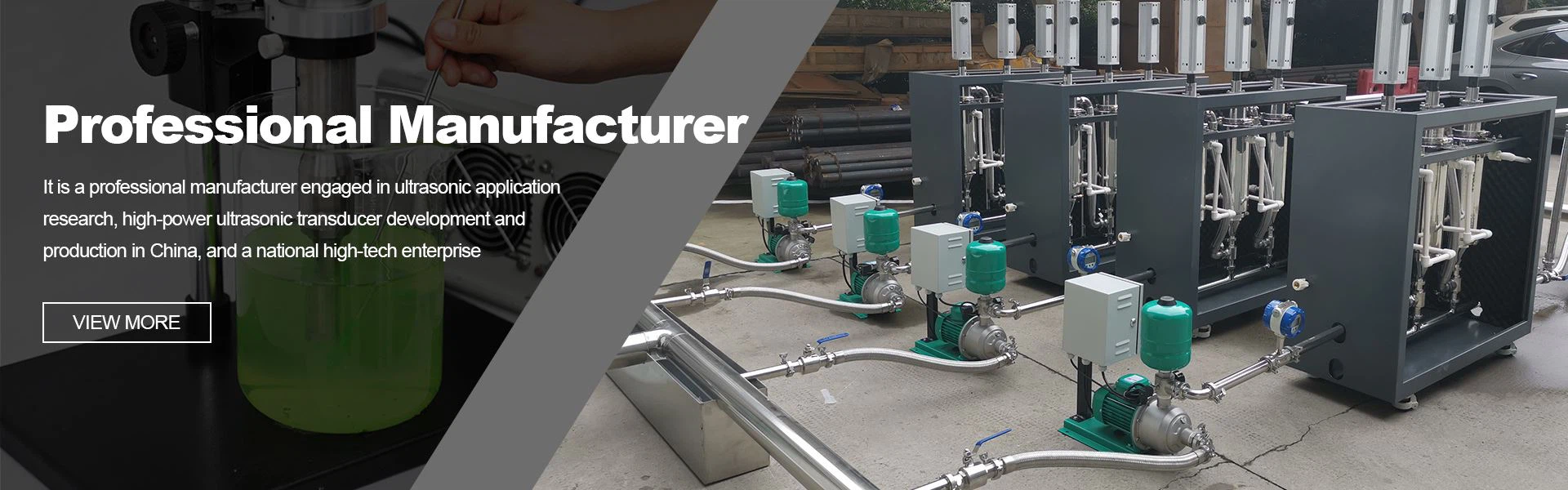

Industrial Ultrasonic Large Scale Graphene Dispersing System
Description
Technical Parameters
20khz 3000w Ultrasonic Dispersion Equipment For Large Scale Graphene Preparation
When sonicating liquids at high intensities, the sound waves that propagate into the liquid media result in alternating high-pressure (compression) and low-pressure (rarefaction) cycles, with rates depending on the frequency. During the low-pressure cycle, high-intensity ultrasonic waves create small vacuum bubbles or voids in the liquid. When the bubbles attain a volume at which they can no longer absorb energy, they collapse violently during a high-pressure cycle. This phenomenon is termed cavitation. During the implosion very high temperatures (approx. 5,000k) and pressures (approx. 2,000atm) are reached locally. The implosion of the cavitation bubble also results in liquid jets of up to 280m/s velocity. The ultrasonically generated cavitation causes chemical and physical effects, which can be applied to processes.
Ultrasonic Preparation of Graphene
Since the extraordinary characteristics of graphite are known, several methods for its preparation have been developed. Beside to chemical production of graphenes from graphene oxide in multi-step processes, for which very strong oxidizing and reducing agents are needed. Additionally, the graphene prepared under these harsh chemical conditions often contain a large amount of defects even after reduction compared to graphenes obtained from other methods. However, ultrasound is a proven alternative to produce high quality graphene, also in large quantities. Researchers have developed slightly different ways using ultrasound, but in general the graphene production is a simple one-step process.
To give an example of a specific graphene production route: Graphite is added in a mixture of dilute organic acid, alcohol, and water, and then the mixture is exposed to ultrasonic irradiation. The acid works as a "molecular wedge" which separates sheets of graphene from the parent graphite. By this simple process, a large quantity of undamaged, high-quality graphene dispersed in water is created.
Innovation:
T caps use replaceable, solve the problem of the tool head cavitation, T caps normal working hours more than 800 hours.
Using the high-power ultrasonic transducer (1500w - 3000w), More stable performance, normal service life more than 10000 hours.
Use of the digitally controlled power, to ensure that all the time in the best condition.
Dumbbell-type tool head design, greatly improving the ultrasonic radiation power per unit area.
The integrated piping made of stainless steel #316.
Overall liquid flow-controllable
Use network-based CAN-bus technology, all working parameters can have room remote control.
Description:
Graphene is composed By carbon atoms lined closely in hexagonal honeycomb lattice of single-layer two dimensional planar structure,was the basic structure of fullerenes, carbon nanotubes and graphite, so it is called the mother of carbon materials
|
Type |
YP-GS10 |
YP-GS25 |
YP-GS50 |
YP-GS100 |
||
|
Annual Yield |
10 ton |
25 ton |
50 ton |
100 ton |
||
|
Frequency |
20Khz |
|||||
|
Power |
3000W /unit |
|||||
|
Total Power |
3000W*6sets |
3000W*12 sets |
3000W *24sets |
3000W*48sets |
||
|
Amplitude/power adjustment range |
20-100% |
|||||
|
Input Voltage |
220V /380 V 50/60Hz |
|||||
|
Installation Area |
10 m2 |
15 m2 |
20 m2 |
40 m2 |
||
|
Features |
Adopt the Mod-Bus technology based on the network, all operating mode parameters can be remotely controlled by the computer |
|||||

Hot Tags: industrial ultrasonic large scale graphene dispersing system, China, suppliers, manufacturers, factory
Previous
No InformationSend Inquiry


