Ultrasound Advances Phase-Change Materials For Energy Storage
Sep 16, 2026
Leave a message
Ultrasonic Processing Technology Advances Phase-Change Materials for Next-Generation Energy Storage
Energy efficiency has become a key focus for industries worldwide. From renewable energy systems and smart buildings to advanced battery technologies, the need for reliable thermal management solutions continues to grow. Phase-change materials (PCMs) are attracting increasing attention because they can store and release large amounts of thermal energy through controlled phase transitions.
However, achieving high-performance PCM systems requires more than selecting suitable materials. Challenges such as particle aggregation, phase instability, limited thermal conductivity, and inconsistent dispersion can affect practical applications. Advanced ultrasonic processing technology provides an effective pathway to improve PCM preparation and support the development of more efficient thermal energy storage solutions.
Why Phase-Change Materials Are Important for Thermal Energy Storage
Phase-change materials store energy in the form of latent heat. During the melting process, PCMs absorb thermal energy, and during solidification, they release the stored heat. This unique working principle allows PCMs to manage temperature fluctuations while maintaining stable thermal conditions.
Today, PCM technology is being explored in many industries, including building energy management, solar thermal storage, battery cooling, electronics protection, and temperature-controlled products. Their ability to store thermal energy efficiently makes them an important material choice for future energy systems.
Challenges in Conventional PCM Development
Although PCMs offer excellent energy storage potential, traditional PCM formulations may encounter several limitations during preparation and operation. Phase separation, supercooling, poor dispersion, and low thermal conductivity can reduce system efficiency and long-term reliability.
For industrial applications, improving material consistency and thermal performance is essential. This requires advanced processing methods capable of controlling PCM structure at both micro- and nanoscale levels.
Ultrasonic Processing: Improving PCM Performance Through Advanced Mixing
High-power ultrasonic processing, also known as sonication, uses acoustic cavitation to create powerful local mixing effects in liquid systems. During this process, microscopic bubbles rapidly form and collapse, generating strong shear forces that improve dispersion and material uniformity.
Compared with conventional mechanical mixing, ultrasonic technology provides more intensive processing at the microscopic level. It helps reduce particle clusters, improve additive distribution, and create more stable PCM formulations.

Key Advantages of Ultrasonic Technology for PCM Applications
Ultrasonic processing delivers several important benefits for PCM manufacturers and researchers:
• Improved dispersion quality - Ultrasonic cavitation helps distribute particles, fillers, and additives more evenly.
• Enhanced stability - Better dispersion reduces aggregation and improves performance during repeated thermal cycles.
• Optimized heat transfer - More uniform PCM structures support faster and more consistent thermal response.
• Advanced material design - Sonication enables the preparation of nano-enhanced and encapsulated PCM systems.
Nano-Enhanced Phase-Change Materials for Higher Thermal Conductivity
One important direction in PCM innovation is the development of nano-enhanced phase-change materials. Nanomaterials such as graphene, carbon nanotubes, and metal oxides can improve thermal conductivity and accelerate heat transfer.
The main challenge is achieving stable nanoparticle dispersion. Because nanoparticles naturally tend to form clusters, effective processing is required. Ultrasonic treatment provides the energy needed to break apart agglomerates and create a more uniform nano-enhanced PCM structure.
Ultrasound-Assisted Nano-Encapsulation of Phase-Change Materials
Nano-encapsulation technology improves PCM reliability by surrounding the phase-change material with a protective shell. These shells, commonly made from polymers, silica, or hybrid materials, help reduce leakage during melting and improve material durability.
Ultrasonic processing plays an important role in producing fine and stable emulsions for capsule formation. The resulting encapsulated PCMs offer improved handling characteristics and expanded application possibilities in coatings, textiles, construction materials, and thermal management systems.
Paraffin Wax PCM Applications Enhanced by Ultrasonic Processing

sonicator YPS17B-HB
Paraffin wax is one of the most widely used organic phase-change materials because of its chemical stability, non-corrosive properties, and suitable melting characteristics. It is commonly considered for applications in construction materials, solar thermal systems, and temperature regulation technologies.
However, paraffin-based systems may experience limitations caused by low thermal conductivity and uneven dispersion. Ultrasonic processing improves droplet distribution, enhances formulation stability, and supports the production of more efficient paraffin PCM systems.
Industrial Ultrasonic Solutions for PCM Production
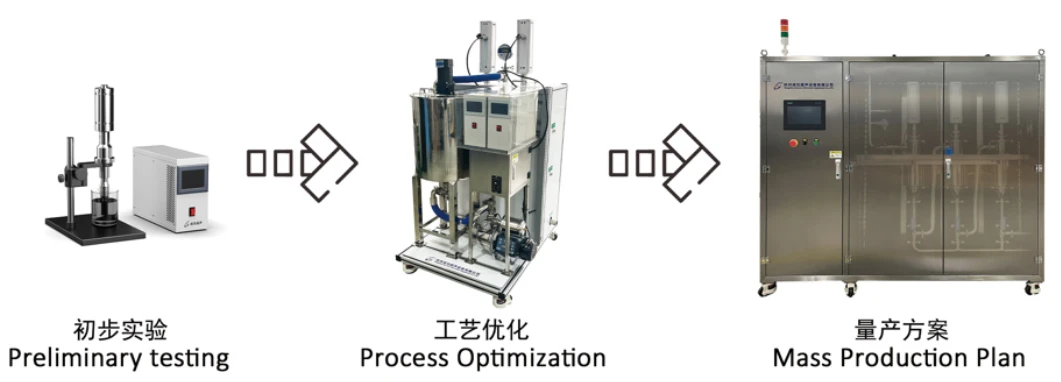
Reliable ultrasonic equipment is essential for developing and manufacturing advanced PCM products. Professional ultrasonic processors provide precise control of processing parameters, helping users achieve repeatable results from laboratory research to industrial production.
Hangzhou Success Ultrasonic Equipment Co.,Ltd provides high-power ultrasonic processing solutions designed for efficient mixing, dispersion, and material preparation. Ultrasonic systems such as YPS61B-MB and YPS17B-HB are suitable for applications requiring stable cavitation performance and reliable processing results.
From Laboratory Research to Industrial Thermal Energy Solutions
The future of thermal energy storage depends not only on advanced materials but also on advanced manufacturing technologies. Ultrasonic processing provides a flexible platform for improving PCM structures, supporting nanoparticle integration, and enabling encapsulation technologies.
By combining material innovation with reliable ultrasonic equipment, phase-change materials can move closer to large-scale industrial applications in energy storage and thermal management.
| Phase-Change Material | Typical use / notes | Advantages achieved by sonication |
|---|---|---|
| Paraffin wax (e.g., RT paraffins, technical paraffins) | Organic PCM; widely used for building materials, thermal packs, electronics cooling. | Sonication creates fine, stable wax-in-water (or wax-in-polymer) dispersions/emulsions, reduces droplet size, improves homogeneity, supports micro-/nanoencapsulation, and enables better filler distribution for faster heat transfer. |
| Fatty acids (e.g., lauric, myristic, palmitic, stearic acid) | Organic PCM; good cycling stability, used in building and thermal buffering. | Ultrasonic emulsification improves phase stability and reduces separation; helps disperse thermal conductivity enhancers (e.g., carbon additives) more uniformly for improved charge/discharge rates. |
| Salt hydrates (e.g., sodium sulfate decahydrate / Glauber's salt, CaCl2·6H2O) | High latent heat; attractive for TES but prone to segregation and supercooling. | Sonication improves dispersion quality and can reduce aggregate size versus conventional stirring, supporting more homogeneous mixtures. In a Glauber's salt dispersion study, sonication was selected as more effective than magnetic stirring at reducing aggregates, and preparation sequence strongly influenced homogeneity and stability. |
| Polyethylene glycols (PEGs) (e.g., PEG 600–6000) | Organic PCM; tunable melting range; used in composites and encapsulated systems. | Sonication improves mixing into polymer matrices, supports formation of uniform PCM droplets for encapsulation, and enhances nanoparticle dispersion (nano-enhanced PCMs) to boost effective thermal conductivity. |
| Sugar alcohols (e.g., erythritol, xylitol, mannitol) | Higher-temperature PCMs; industrial waste-heat recovery, high-temp storage. | Ultrasonic processing enhances deagglomeration of added nucleants/thermal fillers, improves uniformity of suspensions/slurries, and can support more consistent crystallization behavior in formulated systems (especially when combined with nucleating agents). |
| Bio-based oils / esters (e.g., palm oil derivatives, fatty esters) | Renewable organic PCMs; building and packaging applications. | Sonication improves emulsification and stabilizes dispersions, enabling fine droplet distributions, easier incorporation into coatings/polymers, and more reproducible composite PCM production. |
| Eutectic PCMs (organic–organic, salt hydrate blends) | Designed melting points; used when a precise transition temperature is needed. | Ultrasonic mixing accelerates homogenization of multi-component blends, reduces local composition gradients, improves dispersion of stabilizers/nucleants, and supports consistent phase change behavior over cycling. |
| Encapsulated PCMs (micro-/nanoencapsulated paraffins, salt hydrates) | Leakage prevention; easy integration into textiles, coatings, wallboards, and fluids. | Sonication enables stable nanoemulsions and narrow droplet size distributions that translate into more uniform capsule size, improved encapsulation efficiency, reduced leakage, and more predictable thermal response. |
| Nano-enhanced PCMs (PCM + graphene/CNT/metal oxides) | Designed for higher effective thermal conductivity and faster heat exchange. |
Cavitation-driven deagglomeration disperses nanoparticles more uniformly, increasing effective heat transfer pathways, reducing sedimentation risk (with proper formulation), and improving repeatability batch-to-batch. |
Why Choose Ultrasonic Processing for Advanced PCM Development?
Advanced PCM applications require precise processing, stable performance, and scalable manufacturing capability. Ultrasonic technology offers a practical solution for improving PCM quality and accelerating innovation.
With powerful cavitation, flexible processing control, and industrial scalability, ultrasonic systems provide manufacturers and researchers with the tools needed to develop the next generation of thermal energy storage materials.