

How Can Ultrasonic Equipment Be Systematically Adapted To Meet The Diverse Operational Requirements Across Scenarios?
Jan 30, 2026
Leave a message
Ultrasonic Transducer: suitable for welding and processing requirements in multiple industries
As the "core heart" of ultrasonic equipment, the adaptability of the transducer directly determines the process effect. Successfully, we have constructed a product matrix of over 500 types of transducers covering welding, acoustic chemistry, cutting, etc. Through customized design, we have met the precise requirements of different scenarios.
In the field of new energy vehicles: To meet the high precision and high reliability requirements for battery tab welding, the customized metal welding transducer adopts high-performance piezoelectric ceramics and prestressed screws for design, achieving welding accuracy at the micrometer level. The yield rate remains above 99.9%, perfectly adapting to the strict standards of battery production, and becoming the preferred component for leading enterprises in the new energy industry.
Non-woven fabric processing field: In response to the high-speed production demands of masks, hygiene products, etc., the high-speed welding transducer supports efficient operations at a rate of 600 pieces per minute, with energy loss reduced by 15% compared to traditional products. It plays a crucial role in emergency production during the pandemic, balancing production capacity and quality.
High-end manufacturing field: In scenarios such as aerospace and semiconductor manufacturing, the stability requirements for transducers are extremely high. The successful ultrasonic high-end transducers exceed the standard requirements in key indicators such as frequency stability and service life, providing reliable power support for precision component processing.
Ultrasonic Generator: From laboratory to industrialization, covering all process application scenarios
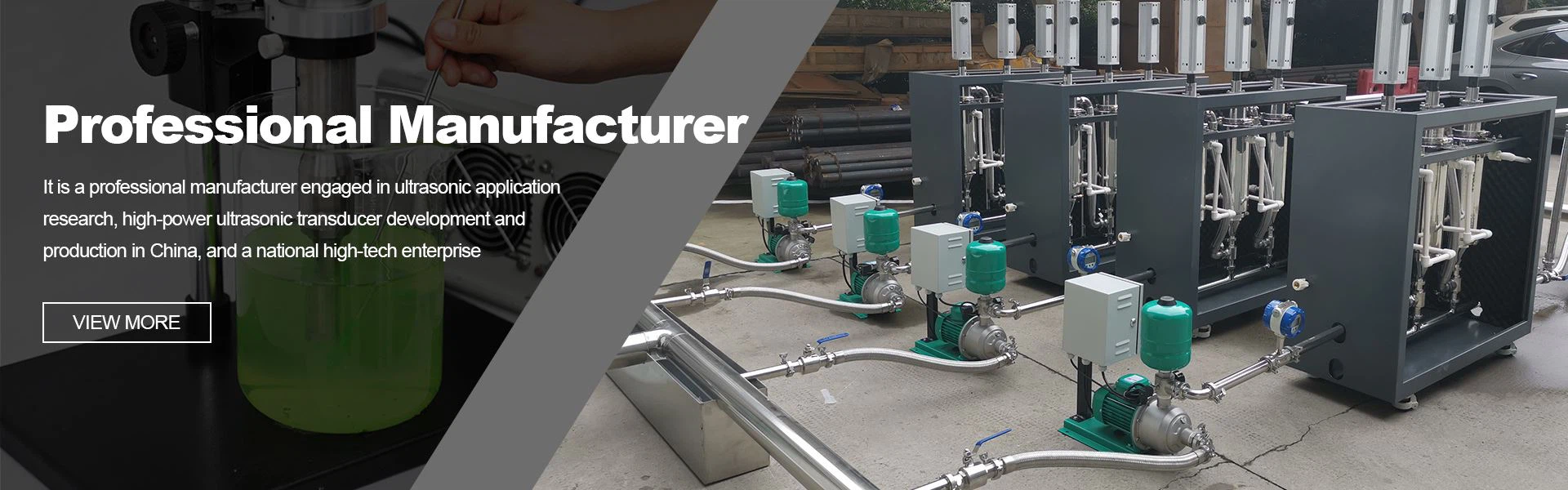
The efficient and green characteristics of sonocoating technology have made it highly favored in various industries. Successfully, through ultrasonic technology, a series of experimental and industrial-grade equipment has been launched, achieving full scene adaptation from research and development to mass production.
New material research and development scenario: In the laboratories of universities and research institutions, the experimental-grade high-energy ultrasonic vibration system, with precise parameter control, has become the core equipment for dispersing graphene and preparing nanomaterials, providing stable and reliable technical support for basic research and facilitating the rapid transformation of scientific research achievements.
New energy material production scenario: In the process of preparing graphene conductive agent for battery power cells, the ultrasonic graphene dispersion equipment can evenly disperse the graphene sheets, and the dispersion stability is improved by 3 times compared to traditional processes. This directly contributes to the increase in battery energy density and meets the technological upgrading requirements of the new energy industry.
Environmental treatment scenario: Industrial wastewater treatment plants are facing the challenge of sludge degradation. The ultrasonic emulsification equipment can increase the decomposition rate of refractory organic matter by 40%. Moreover, the ultrasonic energy-concentrated vibration rod, with its multi-chip matrix design, can cover thousands of liters of reaction vessels, completely solving the problem of blind areas in traditional equipment and meeting the requirements of large-scale environmental treatment.
Fine chemical industry scenario: Processes such as coating dispersion and silicon carbide de-agglomeration have strict requirements for uniformity. The successful ultrasonic sonochemical equipment can achieve efficient homogenization of materials, meeting the high-quality production needs of the fine chemical industry and enhancing product performance.
Measuring Instruments: Compatible with multiple brands, ensuring precise calibration in all scenarios
The stable operation of ultrasonic equipment is inseparable from precise calibration. The successful ultrasonic measurement instrument series features high precision and strong compatibility, enabling it to meet the detection requirements in various scenarios.
Production quality inspection scenario: The YP0901B ultrasonic amplitude measuring instrument adopts the laser interference principle, with a measurement accuracy of up to 0.1 μm. It can monitor the vibration amplitude of the transducer in real time, ensuring consistency in plastic welding, metal processing and other production processes. It has become a key equipment for quality control in manufacturing enterprises.
Equipment operation and maintenance scenario: The C360A transducer analyzer can comprehensively detect key parameters such as impedance characteristics and resonant frequency of the transducer, providing data support for equipment selection and fault diagnosis. It is suitable for equipment maintenance and repair scenarios, thereby reducing operation and maintenance costs.
Multi-brand compatibility scenarios: This series of instruments is not only compatible with the company's own successful ultrasound equipment, but also can be used with mainstream ultrasound equipment from both domestic and international brands. This solves the problems of inconsistent detection standards and poor compatibility within the industry, and is widely applied in the performance testing and calibration of various ultrasound equipment, covering the entire process of research, production, and operation.